
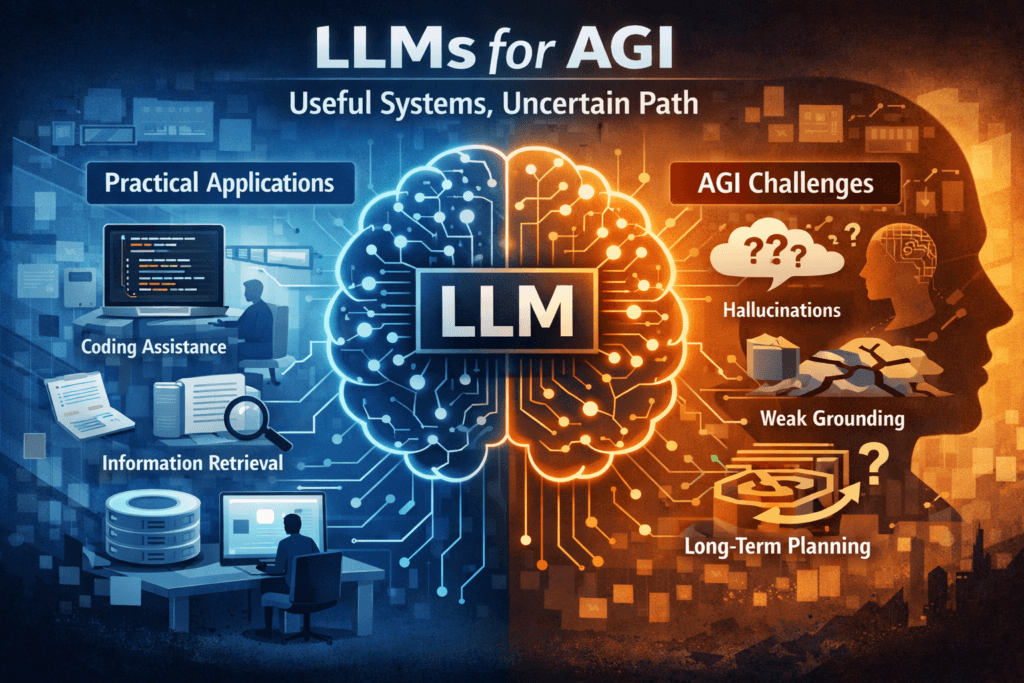
LLMs for AGI is the wrong question if it is asked as a simple yes-or-no bet on destiny. The more useful question is whether large language models are enough, on their own, to reach human-level general intelligence across the messy range of tasks that matter in the real world. Right now, the evidence suggests a more restrained answer: LLMs are commercially powerful, technically impressive, and strategically important, but they may still be a local maximum rather than a straight road to AGI.
That is not a dismissal. It is a clarification.
A lot of public discussion still bundles together three different ideas as if they were the same thing: strong language capability, broad benchmark performance, and general intelligence. They are not the same. Current models can write, summarize, classify, retrieve, translate, draft code, assist with research, and help automate many narrow or semi-structured workflows. Those are real capabilities with real economic value. But useful does not automatically mean general, and benchmark progress does not automatically mean deep understanding.
For decision-makers, this distinction matters. If you think current progress in LLMs for AGI proves that human-level intelligence is near, you may overinvest in fragile autonomy, underestimate operational risk, or mistake polished outputs for durable competence. If you swing too far the other way and conclude that current models are worthless because they are not AGI, you miss immediate gains in productivity, search, support, coding assistance, and document-heavy workflows.
The more grounded view is this: LLMs are powerful statistical systems that can compress, reproduce, and transform patterns in language and code at extraordinary scale. That makes them useful. It does not yet make them generally intelligent.
Why LLMs feel smarter than they are
The modern LLM stack is built on the transformer architecture introduced in 2017, then scaled through massive pretraining, fine-tuning, reinforcement learning, and increasingly sophisticated inference-time methods. At a high level, these systems learn statistical structure from large corpora and generate outputs token by token. That basic setup is enough to produce surprisingly broad behavior because so much human knowledge, process, and reasoning is mediated through text and code.
This is why LLMs for AGI remains a tempting narrative. Language covers a huge share of knowledge work. Many business processes are text-shaped. A model that can imitate expert discourse, write working code, follow instructions, and answer domain questions can appear to be crossing from tool to mind.
But appearance is doing a lot of work there.
A system can be highly capable in language without possessing a stable world model, durable long-horizon planning, grounded perception, or the kind of transfer that people usually mean by general intelligence. In fact, some of the strongest critiques of LLM scaling are not saying the models are useless. They are saying the opposite: the models are useful enough to fool people into over-interpreting what the underlying mechanism achieves.
That warning has held up well.
OpenAI’s own 2025 research on hallucinations framed a core issue bluntly: language models are often rewarded for guessing rather than admitting uncertainty. Anthropic’s research and API guidance make a similar point in practice by showing that refusal behavior, grounding, and quote-first workflows can reduce hallucinations but not eliminate them. In other words, current systems can often be made more reliable, but reliability still requires scaffolding, constraints, and external grounding rather than blind trust (https://openai.com/index/why-language-models-hallucinate/) (https://platform.claude.com/docs/en/test-and-evaluate/strengthen-guardrails/reduce-hallucinations).
That is an important clue. If raw model intelligence were already robust and general, so much production engineering would not be dedicated to managing uncertainty, routing around failure modes, and constraining outputs.
What LLMs actually do well right now
A skeptical view of LLMs for AGI should not lead to a weak view of present-day utility. Current models do several things extremely well, especially when the task is language-rich, pattern-dense, and success can be improved by retrieval, review, or human oversight.
LLMs are strong at compression and transformation
Summarization, rewriting, extraction, classification, question answering over bounded corpora, coding assistance, test generation, and structured drafting all play to the strengths of LLMs. These are not toy tasks. In many companies, they touch legal reviews, support operations, software delivery, research synthesis, sales enablement, and internal knowledge access.
This is where the commercial case for LLMs is strongest. You do not need AGI to save teams time on repetitive language work. You need systems that are fast, good enough, monitorable, and integrated into the workflow.
LLMs are strong when combined with retrieval and tools
The most reliable AI products today usually do not rely on the model alone. They use retrieval-augmented generation, tool calling, verification steps, or structured execution paths. That matters because it means the model is often acting less like a fully autonomous agent and more like a probabilistic interface layer over external systems.
This is not a weakness in product terms. It is often the correct architecture.
LLMs are strong at coding assistance, but not full software autonomy
Coding is one of the most persuasive domains because code is formal enough to be checkable and text-like enough to fit the model’s training strengths. Frontier systems can help generate functions, explain APIs, refactor boilerplate, write tests, and accelerate debugging. But even here, the gap between “helpful assistant” and “reliable independent engineer” remains large.
Research from METR has shown meaningful progress in the length of software tasks frontier AI systems can complete, but that same work also highlights that task duration and real-world reliability remain limiting factors. Progress is real. Full autonomy is still a stretch (https://metr.org/blog/2025-03-19-measuring-ai-ability-to-complete-long-tasks/).
Where the LLMs for AGI story starts to break
The case against LLMs for AGI is not that they fail at everything. It is that their strongest wins may come from exploiting broad but shallow regularities in human-generated data rather than acquiring the kind of robust, grounded, general-purpose competence AGI would require.
They still hallucinate, even when they sound certain
Hallucination is not a cosmetic issue. It is a structural reliability problem. Current models can produce fluent wrong answers, invented citations, false tool interpretations, and plausible but broken reasoning traces. Better training and evaluation can reduce the rate. Prompting can help. Retrieval can help. Tool use can help. But a model that still confidently fabricates when uncertain is hard to describe as generally intelligent in the operational sense that matters to businesses.
They are brittle under distribution shift
Models often perform best in formats and domains that resemble their training distribution. Change the framing, add noise, increase ambiguity, or require novel abstraction under constrained conditions, and performance can drop sharply. A general intelligence system should not collapse simply because a problem arrives in a less familiar wrapper.
This is one reason benchmark worship is dangerous. Benchmarks matter, but they can be contaminated, overfit indirectly, or optimized in ways that do not map cleanly onto robust generalization.
They are not well-grounded in the world
Text alone is a strange basis for intelligence. Much of human competence depends on embodiment, causality, physical interaction, persistent goals, and feedback from reality. Even multimodal systems do not automatically solve that gap. Seeing images or hearing speech is not the same as inhabiting the world, testing hypotheses through action, and maintaining stable causal models over time.
If AGI requires deeper grounding than next-token prediction plus tools can provide, then LLMs may be an incomplete substrate rather than the whole answer.
Long-horizon planning remains weak
Many impressive demos are still short-horizon and heavily managed. The system succeeds because the task is bounded, the environment is simplified, or humans quietly provide the missing structure. Once tasks become open-ended, involve hidden state, require persistent memory, or demand reliable decomposition over long chains of action, failure rates rise.
That matters because a lot of what people mean by AGI is not just answering hard questions. It is operating competently over time in changing environments.
The strongest case for LLMs as a path to AGI
A serious article should not straw-man the opposite side. The strongest argument in favor of LLMs for AGI goes something like this.
First, scaling has worked better than many experts expected. Larger models trained on more data with more compute have repeatedly unlocked emergent-looking capabilities in coding, math, translation, tool use, and multimodal tasks.
Second, language may be a richer interface to intelligence than critics admit. A large share of human knowledge is encoded in language, diagrams, code, and formal systems. If a model can absorb and manipulate that structure well enough, perhaps what looks like “mere pattern matching” becomes functionally close to reasoning for many purposes.
Third, inference-time compute appears to matter. Reasoning models can spend more computation per problem, produce intermediate traces, and sometimes outperform standard models on harder tasks. That suggests pure pretraining scale may not be the whole story.
Fourth, hybridization is allowed. Even if raw LLMs are insufficient, a broader architecture built around language models, tools, memory, search, planning modules, simulators, and multimodal grounding might still be the route.
That is a respectable case. It should not be dismissed casually.
Why that case still does not settle the issue
The problem is that none of those points proves that current LLM scaling trends are converging on general intelligence rather than extending a highly useful but bounded paradigm.
More capability is not the same as generality
A system can get much better on many tasks without becoming generally intelligent. It may simply be extending the reach of interpolation over a much larger and richer space. That can still look dramatic from the outside.
Reasoning traces are not proof of reasoning
Apple’s 2025 paper on “The Illusion of Thinking” argued that large reasoning models can show improved performance on some tasks while still exhibiting collapse as complexity rises in controlled settings. Whether every conclusion in that paper will hold up over time is still being debated, but its core caution is important: verbose intermediate text is not the same as a validated internal algorithmic solution (https://machinelearning.apple.com/research/illusion-of-thinking).
Hard benchmarks still expose gaps
ARC-AGI remains relevant because it aims at a kind of fluid abstraction that humans find easy and many AI systems still find difficult. The fact that frontier systems have improved does not erase the benchmark’s original point: some kinds of generalization do not appear automatically from scaling language prediction alone (https://arcprize.org/blog/announcing-arc-agi-2-and-arc-prize-2025).
Even AGI definitions remain unsettled
Google DeepMind’s work on “Levels of AGI” is useful partly because it admits the measurement problem. Before claiming victory, the field still has to define what counts as generality, across what breadth of tasks, and against what human baseline (https://deepmind.google/research/publications/66938/) (https://blog.google/innovation-and-ai/models-and-research/google-deepmind/measuring-agi-cognitive-framework/).
That is not a trivial footnote. It means many public claims about proximity to AGI are arguments layered on top of disputed definitions and imperfect metrics.
Why AGI may still be decades away, or unattainable
This is where intellectual honesty matters most.
It is possible that AGI arrives sooner than skeptics expect through continued scaling, better architectures, richer multimodal training, tool use, and more compute at inference. But it is also possible that the current paradigm hits diminishing returns on the hardest dimensions of intelligence.
Several obstacles stand out.
One is grounding. Another is robust causal reasoning. Another is long-term memory and identity across contexts. Another is autonomy under uncertainty without catastrophic error. Another is transfer to unfamiliar situations where the system cannot lean on dense prior examples. Another is the still open question of whether text-trained predictive systems can build sufficiently rich world models without deeper forms of action and feedback.
There is also a more basic possibility: “general intelligence” may not be a single engineering hill that falls once models become big enough. It may require multiple interacting capacities that today’s systems only partly simulate.
And there is an even harder possibility: AGI in the full human-comparable sense may be far less tractable than the current market narrative implies.
None of this makes present AI disappointing. It just puts it in the right category.
The practical business takeaway
For most organizations, the strategic question is not whether LLMs for AGI will culminate in machine super-minds. The strategic question is where these systems create reliable advantage now.
That answer is clearer than the AGI debate.
Use LLMs where language is the bottleneck, where outputs can be checked, where retrieval can ground responses, where human review is acceptable, and where the workflow benefits from speed more than it demands perfect autonomous judgment.
Be cautious where errors are expensive, where facts must be exact, where long-horizon planning is required, where hidden state matters, or where the model is being asked to operate beyond the evidence it can actually ground.
In other words, treat LLMs less like junior humans and more like powerful, fallible statistical engines that can sit inside a well-designed system.
That mindset leads to better architecture and better governance. It also reduces the chance that you buy into inflated claims on one side or miss practical value on the other.
So, are LLMs a dead end for AGI?
The honest answer is: possibly, but not conclusively.
LLMs for AGI may turn out to be a dead end in the strict sense that language modeling alone never reaches durable general intelligence. They may also turn out to be a partial foundation that needs major additions around memory, action, planning, grounding, and verification. Or they may continue surprising critics while still falling short of the strongest AGI claims for much longer than enthusiasts expect.
What the evidence supports today is narrower and more useful than either extreme.
Large language models are not a failure because they may not become AGI. They are already valuable because they can compress, synthesize, retrieve, draft, and assist across a wide range of economically relevant tasks. That matters.
At the same time, their weaknesses are not minor cosmetic bugs that can be waved away with better prompting. Hallucination, brittleness, limited grounding, fragile long-horizon behavior, and the ambiguity of benchmark progress are all serious constraints. Those constraints do not prove that AGI is impossible. They do show that current systems should be evaluated as tools with real boundaries, not as inevitable proto-minds.
That is the useful but uncomfortable truth.
If you are evaluating AI strategy, that truth is enough. You do not need certainty about AGI timelines to make good decisions. You need a clear view of what current models actually do well, where they fail, and how to capture real value without inheriting fantasy as strategy.
FAQ
Are LLMs the same thing as AGI?
No. Large language models are a specific class of AI systems trained primarily on patterns in text, code, and increasingly multimodal data. AGI usually refers to much broader, more durable, and more transferable intelligence across domains and environments.
Can LLMs still be useful if they never become AGI?
Yes. They already create value in summarization, search, coding assistance, customer support, document workflows, knowledge retrieval, and other language-heavy tasks. Their usefulness does not depend on reaching AGI.
Why do benchmark gains not prove general intelligence?
Because benchmarks can be narrow, partially contaminated, or optimized in ways that do not translate into robust performance in messy real-world settings. High scores show progress, but they do not settle the question of generality.
What is the biggest limitation of current LLMs?
There is no single limitation, but reliability is central. Hallucination, weak grounding, brittle long-horizon planning, and uneven performance under distribution shift all limit how far current systems can be trusted without supervision or scaffolding.
Could hybrid systems still lead to AGI?
Possibly. One serious view is that language models may be only one component in a larger architecture that includes tools, memory, planning, world interaction, and verification. That is different from claiming raw LLM scaling alone will get there.
Should companies wait for AGI before investing in AI?
No. The practical gains available now are already meaningful. The better approach is to deploy AI where it is useful and measurable today, while staying skeptical of exaggerated claims about full autonomy or near-term AGI.
Sources
- OpenAI, Why Language Models Hallucinate: https://openai.com/index/why-language-models-hallucinate/
- OpenAI, Why Language Models Hallucinate (paper PDF): https://cdn.openai.com/pdf/d04913be-3f6f-4d2b-b283-ff432ef4aaa5/why-language-models-hallucinate.pdf
- Anthropic, Tracing the Thoughts of a Large Language Model: https://www.anthropic.com/research/tracing-thoughts-language-model
- Anthropic, Reduce Hallucinations Documentation: https://platform.claude.com/docs/en/test-and-evaluate/strengthen-guardrails/reduce-hallucinations
- Google DeepMind, Levels of AGI for Operationalizing Progress on the Path to AGI: https://deepmind.google/research/publications/66938/
- Google DeepMind, Measuring Progress Toward AGI: A Cognitive Framework: https://blog.google/innovation-and-ai/models-and-research/google-deepmind/measuring-agi-cognitive-framework/
- Apple Machine Learning Research, The Illusion of Thinking: https://machinelearning.apple.com/research/illusion-of-thinking
- ARC Prize, Announcing ARC-AGI-2 and ARC Prize 2025: https://arcprize.org/blog/announcing-arc-agi-2-and-arc-prize-2025
- METR, Measuring AI Ability to Complete Long Tasks: https://metr.org/blog/2025-03-19-measuring-ai-ability-to-complete-long-tasks/
- Vaswani et al., Attention Is All You Need: https://arxiv.org/abs/1706.03762
- Bender et al., On the Dangers of Stochastic Parrots: https://dl.acm.org/doi/10.1145/3442188.3445922
Related Articles from Kyle Beyke
- Small Language Models: Smart Wins at the Edge: https://beykeworkflows.com/small-language-models-smart-wins-edge/
- Synthetic Data: Essential Rules for Better Training: https://beykeworkflows.com/synthetic-data-essential-rules-better-training/