
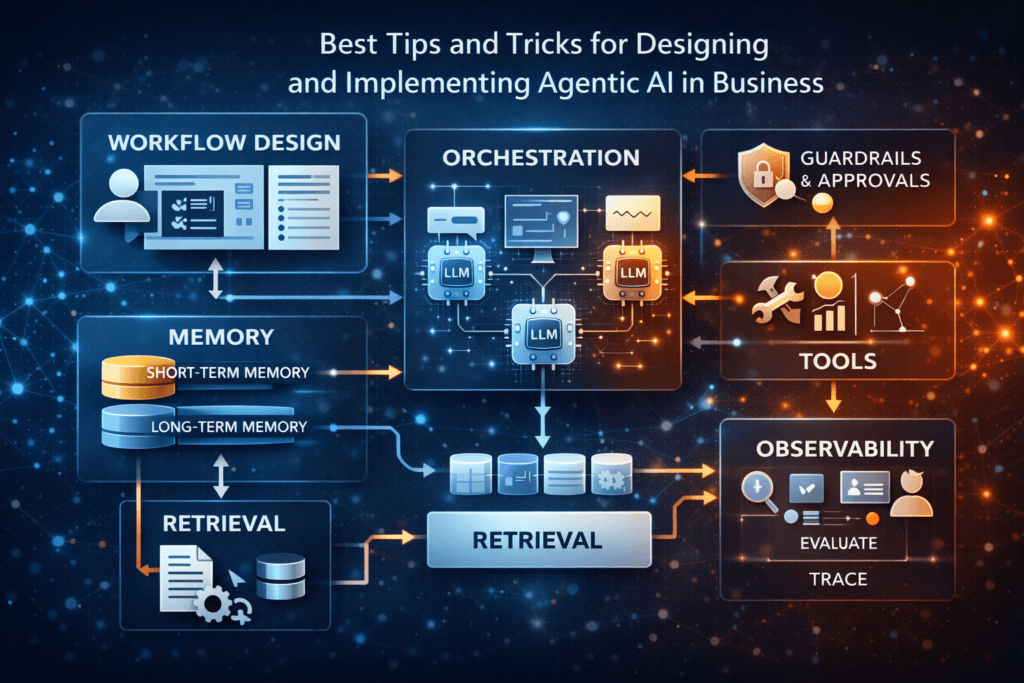
Agentic AI business systems work best when they are designed like controlled software systems rather than oversized chat prompts. The most credible guidance from OpenAI, Anthropic, and Google Cloud all points in the same direction: reliable business agents combine models with orchestration, tools, external memory, retrieval, guardrails, and observability. That is where performance becomes repeatable instead of accidental.
A lot of teams still start in the wrong place. They look for one model that can reason, remember, act, and self-correct all at once. In production, that usually breaks down. The stronger pattern is to reduce what the model must hold in active context and surround it with systems that manage state, tool choice, permissions, and evaluation. Google Cloud’s architecture guidance explicitly describes agent design as an iterative process, while OpenAI frames agents as systems built from models, tools, and orchestration.
Why agentic AI business design matters
Business workflows are rarely one-shot interactions. They involve changing state, multiple systems, approvals, retrieval, policy checks, and long-running tasks. That is why recent guidance focuses less on prompt cleverness and more on architecture choices such as external state management, design patterns, and context engineering. Anthropic’s context engineering guidance defines the problem as curating and maintaining the optimal set of tokens during inference, which is a much better description of the real work than “writing a better prompt.”
1) Start with the workflow, not the model
The first strong move is to map the workflow before choosing the model stack. Google Cloud recommends selecting architecture components based on workload characteristics, performance needs, cost, and security requirements, and its design-pattern guide says agent patterns should be chosen according to the workflow being organized.
In practice, that means defining the job first: what the agent can read, what it can change, what requires approval, what counts as success, and where humans stay in the loop. Many teams discover that their use case does not need unrestricted autonomy at all. It may only need a constrained assistant, a staged workflow, or a handoff-based agent. That decision is architectural, not cosmetic.
2) Split planning from execution
OpenAI’s reasoning best-practices guidance recommends using reasoning models for harder planning and judgment tasks and combining them with faster GPT-style models for more straightforward execution work. That is a practical way to keep quality high without paying reasoning-model cost for every step.
This is one of the best agentic AI business tricks available right now. Let the stronger model decide what to do next when ambiguity is high. Let cheaper, faster models handle predictable steps such as formatting, extraction, or templated outputs. That separation often improves consistency and lowers cost at the same time.
3) Keep memory and state outside the prompt
Google Cloud’s architecture guidance makes a useful distinction between short-term memory and long-term memory and recommends external state management so stateless application instances can continue work reliably. That is exactly the right pattern for business systems that need scalability, resumability, and auditability.
A practical agentic AI business setup usually separates:
- working memory for the current task
- durable memory for preferences, policies, and recurring facts
- execution state for completed and pending steps
- external records for documents, tickets, logs, and tool outputs
That keeps the model from re-deriving what the system should already know, and it reduces the chance that long histories become noisy and unmanageable.
4) Retrieve context just in time
Anthropic’s context-engineering guidance argues for curating the smallest high-signal set of tokens needed for success and recommends lightweight references with context loaded at runtime through tools. That is a major improvement over the old habit of flooding the prompt with documents up front.
For business systems, this has immediate benefits: lower cost, less noise, better focus, and more predictable behavior. Instead of trying to make the model remember the whole company, good systems help it retrieve the right policy, record, or document at the moment it is needed.
5) Use fewer tools, but make them sharper
Anthropic’s tool-building guidance is direct: agents are only as effective as the tools they are given, and tool descriptions, examples, schemas, and parameters materially affect performance. It also notes that tool quality should be evaluated, not assumed.
This matters because bloated toolsets create ambiguity. A smaller set of narrow, well-described, strongly typed tools usually performs better than a giant menu of overlapping actions. One of the best practical tricks is to remove tools until the choice is obvious. If an engineer cannot explain which tool should be used in a given situation, the agent probably will not choose correctly either.
6) Separate read permissions from write permissions
Security and governance are not extra layers. They are part of the architecture. Google Cloud’s guidance highlights IAM restrictions, secure execution, network controls, and governance as core considerations when selecting components for agentic systems.
One of the safest business patterns is to default the system to read-only access and make write actions harder to reach. Updating records, sending customer messages, touching financial systems, or making production changes should sit behind stronger checks than routine retrieval. This reduces the blast radius when the agent misfires.
7) Put approvals where the downside is high
The goal is not to put a human in every loop. The goal is to put a human in the right loops. OpenAI’s stateful agent runtime guidance emphasizes working context, tool and workflow state, and permission boundaries, while Anthropic’s autonomy work notes that many present-day agent actions remain low-risk and reversible.
That supports a simple implementation rule: add approval gates before destructive actions, external communications, policy-sensitive decisions, security-relevant changes, or anything with material financial impact. Those are the places where a short pause is cheaper than a bad autonomous decision.
8) Make the workflow observable
OpenAI’s agent announcements emphasize tracing and observability because agent failures usually happen across chains of decisions, not in one final answer. Without tracing, teams cannot see whether the problem came from bad retrieval, weak planning, the wrong tool, or a broken state transition.
The best business systems log the path: tool calls, retrieval events, state changes, approvals, retries, and outcomes. That turns the agent from a black box into something that can actually be tuned. Observability is one of the clearest differences between a demo and a real system.
9) Evaluate the full agentic AI business workflow
Anthropic recommends evaluating tools and agent behavior comprehensively, and Google Cloud’s architecture materials frame design as iterative rather than fixed. That means prompt tests alone are not enough.
A strong evaluation set should test whether the system retrieved the right evidence, chose the right tool, followed policy, requested approval when needed, and updated state correctly for the next step. Those checks expose the real failure modes in production systems. The best teams improve agents by improving the workflow around them, not by endlessly tweaking wording in a prompt.
The real takeaway for agentic AI business teams
The strongest agentic AI business systems are not the ones that ask the model to do everything. They are the ones that reduce uncertainty with better architecture: explicit workflows, model separation, external memory, just-in-time retrieval, cleaner tools, permission boundaries, approval gates, tracing, and evaluation. That pattern appears consistently across current OpenAI, Anthropic, and Google Cloud guidance.
The practical lesson is simple. Treat the model as one part of the system, not the system itself. That is how you get from interesting prototypes to reliable business operations.
Frequently Asked Questions
What is the most important agentic AI business principle?
The most important principle is to design the agent as a system, not a standalone model. Reliable business performance comes from orchestration, memory, retrieval, tools, permissions, and evaluation working together.
Why does agentic AI business architecture matter more than prompt quality?
Because business workflows are multi-step, stateful, and sensitive to mistakes. Architecture controls how the system retrieves information, tracks state, uses tools, and limits risk. Prompts still matter, but they are only one layer.
Should businesses use one agent or many?
It depends on the workflow. Google Cloud’s design-pattern guidance says the right pattern depends on workload complexity, integration needs, and governance requirements. Narrow tasks often work with one orchestrated agent, while more specialized workflows may benefit from multiple agents.
How do businesses reduce risk in agentic AI systems?
The standard methods are external state, limited write permissions, approval checkpoints, secure execution environments, and strong observability. Those controls reduce the cost of mistakes and make the system easier to govern.
Why is just-in-time retrieval important?
Because it keeps the active context smaller and more relevant. Anthropic’s context-engineering guidance specifically recommends curating the optimal token set and loading needed information through tools at runtime.
Sources
- OpenAI – New tools for building agents
- Google Cloud – Choose your agentic AI architecture components
- Google Cloud – Choose a design pattern for your agentic AI system
- Anthropic – Effective context engineering for AI agents
- Anthropic – Writing effective tools for agents
- Anthropic – Building Effective AI Agents
- Rank Math – Power Words: The Art of Writing Headlines That Get Clicked
- Rank Math – Keyword Research Guide for SEO Success
More from beykeworkflows.com
AI Model Selection: Powerful Guide for Smart Business AI
Powerful Text Classification, Extraction, and Summarization with AI
AI Workflow Anatomy: Essential Guide for Business