
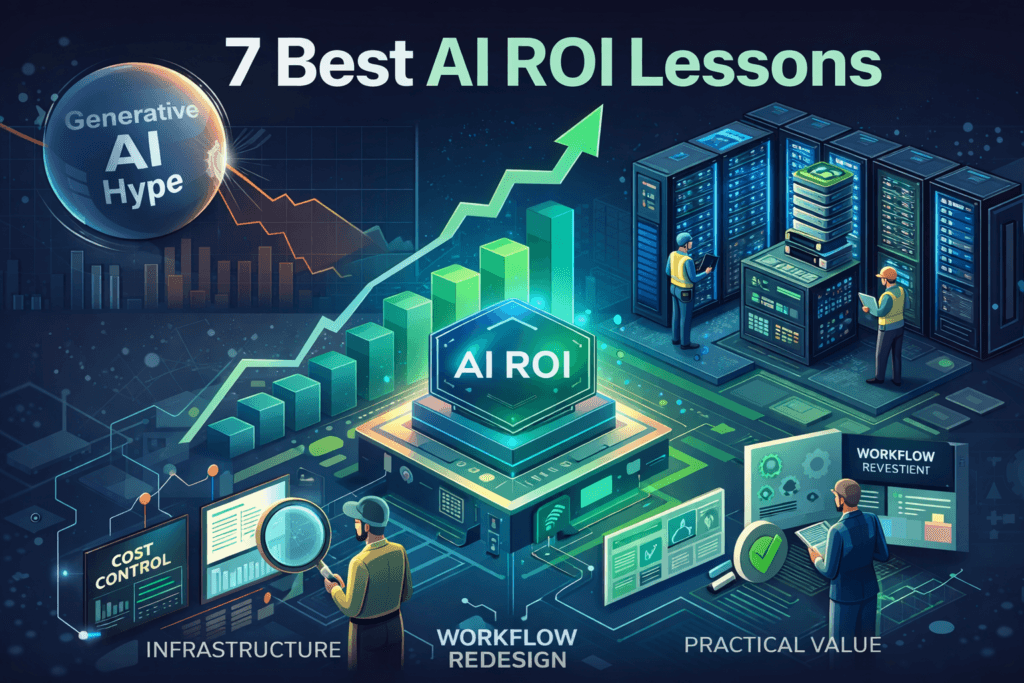
AI ROI is becoming the real filter for serious enterprise adoption. That is the clearest sign that the market is moving beyond the early generative AI hype cycle. Companies are still spending aggressively on AI, but the conversation is less about novelty and more about measurable value, workflow redesign, operating discipline, and the infrastructure needed to support production use. Gartner expects worldwide generative AI spending to reach $644 billion in 2025, yet it also says at least 30% of generative AI projects will be abandoned after proof of concept by the end of 2025 because of poor data quality, inadequate risk controls, escalating costs, or unclear business value. That is not a contradiction. It is what market maturation looks like.
The easiest way to misread the current moment is to call it an AI collapse. The more accurate reading is that the market is becoming less forgiving. Capital is still flowing into AI, but organizations are getting stricter about what counts as success. McKinsey’s 2025 State of AI report says the biggest driver of EBIT impact from generative AI is workflow redesign, not simply model access. Deloitte’s 2024 year-end generative AI survey says 74% of respondents report that their most advanced initiative is meeting or exceeding ROI expectations, but it also says time to value has been longer than expected. IBM’s 2025 CEO study adds another useful tension: 65% of CEOs say they prioritize AI use cases based on ROI, yet only 52% say their organizations are realizing value from generative AI beyond cost reduction. That combination tells the real story. AI interest is broad, but value realization is uneven.
That is why the phrase “bubble deflation” is more useful than “bubble burst.” In a burst, the underlying category collapses. In a deflation, the exaggerated expectations come down to earth while the durable parts remain. The durable parts of AI right now are not hard to identify: infrastructure spending, production deployment, domain-specific use cases, workflow redesign, and tighter measurement of AI ROI. Companies are still investing, but they increasingly want proof that an AI system reduces cycle time, improves throughput, raises revenue per employee, lowers service cost, or improves decision quality in a way that survives scrutiny from finance and operations.
Why AI ROI is replacing AI hype
Early generative AI enthusiasm was shaped by visible model capabilities. Text generation, coding assistance, summarization, and image generation made the technology feel immediate and flexible. But enterprise value rarely comes from a capability demo alone. It comes from fit with a workflow, access to data, operational controls, cost discipline, and the ability to deploy at scale without breaking quality or governance. OpenAI’s business guide on agents makes this explicit by arguing that real value comes from building around actual workflows, starting small, validating with real users, and optimizing for cost and latency instead of assuming the biggest model is always the right answer.
That is also why many projects stall after the proof-of-concept stage. Gartner’s 2024 forecast that at least 30% of generative AI projects would be abandoned after proof of concept by the end of 2025 was not just a warning about technical weakness. It was a warning about discipline. Poor data quality, inadequate risk controls, escalating costs, and unclear value are all signs that the real bottleneck is implementation quality rather than raw model intelligence. Gartner’s 2025 note that over 40% of agentic AI projects could be canceled by the end of 2027 for escalating costs, unclear business value, or inadequate risk controls reinforces the same point. Organizations are no longer rewarding AI projects for sounding ambitious. They are rewarding them for surviving operational reality.
For executives, that changes the decision standard. The question is no longer, “Can AI do this task?” The better question is, “Can AI do this task reliably enough, cheaply enough, and at enough scale to matter to the business?” That is a much harder bar, and it is the bar that AI ROI forces companies to use. Once finance teams, operating leaders, and infrastructure owners get involved, the market naturally shifts away from speculative excitement and toward measurable value.
Lesson 1: The bubble is deflating, but spending is not disappearing
One of the clearest signs that this is a discipline shift rather than an AI retreat is that spending remains strong. Gartner forecasts global generative AI spending of $644 billion in 2025. Microsoft said in its FY2025 fourth quarter materials that Azure surpassed $75 billion in annual revenue, up 34%, while the company added more than two gigawatts of new datacenter capacity over the prior 12 months. Alphabet said Google Cloud revenue rose 32% to $13.6 billion in Q2 2025 and raised its expected 2025 capital expenditures to about $85 billion, primarily because of demand for cloud products and technical infrastructure. These are not the signals of a market that has lost relevance. They are the signals of a market shifting from lightweight experimentation to expensive production infrastructure.
What is deflating is the assumption that every AI project is automatically strategic. Investors and operators are getting more selective. The market is still willing to fund platforms, datacenters, GPUs, and cloud capacity because those are infrastructure bets on broad demand. But inside enterprises, many individual use cases are now being asked to justify themselves much more directly. In other words, aggregate AI investment can keep rising even while weak AI projects get cut. That is exactly what a transition from hype to AI ROI should look like.
Lesson 2: Workflow redesign matters more than model novelty
McKinsey’s 2025 State of AI report is one of the most useful sources on this point. Among 25 attributes it tested, workflow redesign had the biggest effect on an organization’s ability to see EBIT impact from generative AI. It also found that 21% of respondents whose organizations use generative AI say they have fundamentally redesigned at least some workflows as part of deployment. That matters because it moves the discussion away from the model as the product. In most businesses, the value is created when the workflow changes: when a support process becomes faster, when a research loop becomes more automated, when a sales or compliance process sheds manual work, or when engineering throughput improves in a measurable way.
This is one of the simplest ways to separate hype from value. Hype asks whether the model is impressive. AI ROI asks whether the operating model changed. If the answer is no, then even a strong model may not matter much economically. If the answer is yes, the gains can become visible in cost, speed, quality, or output. That is also why so many AI pilots disappoint. They prove the model can produce something useful, but they never reach the much harder work of process integration, data access, control design, and user adoption.
Lesson 3: Time to value is real, and it is forcing better prioritization
A lot of the AI hype cycle was fueled by the assumption that value would arrive quickly and broadly. Deloitte’s 2024 year-end enterprise survey gives a more grounded picture. It says nearly three-quarters of respondents report that their most advanced initiative is meeting or exceeding ROI expectations, but it also says the time to value has been longer than expected. Cybersecurity and IT are leading in ROI and successful scaling, while regulatory uncertainty, risk management, and organizational barriers still slow wider deployment. That combination is important. It suggests that AI can produce strong returns, but not necessarily at the speed or breadth early hype implied.
That is exactly the kind of condition that pushes the market toward AI ROI discipline. When value takes longer to surface, companies start prioritizing projects more carefully. They look for domains where the path from deployment to economic impact is clearer. They cut vanity projects. They favor use cases with measurable labor savings, throughput gains, risk reduction, or revenue support. That is not anti-innovation. It is normal capital allocation behavior once a technology moves from fascination to implementation.
Lesson 4: Infrastructure is becoming part of the value equation
The AI conversation used to be dominated by models and applications. It is now equally about infrastructure. Microsoft’s recent earnings materials show AI demand shaping both revenue growth and gross margin pressure, with Microsoft Cloud gross margin impacted by the cost of scaling AI infrastructure. Alphabet’s Q2 2025 call said the vast majority of its Q2 capital expenditures went into technical infrastructure, with roughly two-thirds in servers and one-third in datacenters and networking gear, and that the company still expected a tight demand-supply environment into 2026. Google also linked its higher 2025 CapEx outlook to additional investment in servers and faster datacenter construction to meet cloud demand.
This matters for AI ROI because infrastructure is no longer a background detail. It is part of the economics. AI workloads can be expensive to run, especially when enterprises move from toy usage to production usage with retrieval, agents, fine-tuning, security controls, and high availability. That pushes organizations to ask better questions about model choice, inference cost, throughput, latency, and where a workflow actually needs a premium model versus a cheaper one. OpenAI’s own guidance reflects this by recommending that teams meet accuracy targets first and then optimize for cost and latency, including replacing larger models with smaller ones where possible.
In practical terms, the market is learning that AI value has a systems cost. That does not make AI less useful. It just means the return has to be measured against a more realistic cost base. When organizations start accounting for infrastructure, governance, integration, and operational support, they stop treating AI as cheap magic and start treating it as enterprise software and compute. That is one of the strongest signs that the bubble is deflating into something more durable.
Lesson 5: Productivity claims need economic context
One of the reasons AI enthusiasm has remained strong is that there is real evidence of productivity effects. PwC’s 2025 Global AI Jobs Barometer found that industries best positioned to use AI have seen nearly quadrupled productivity growth since 2022, while revenue generated per employee grew three times faster in industries more exposed to AI. PwC also found a 56% wage premium for workers with AI skills. Those are meaningful findings, and they support the idea that AI can create real economic value.
But productivity is not the same thing as realized AI ROI. A productivity gain has to travel through the business model before it becomes economic return. If a team produces work faster but the organization does not redesign roles, reduce cycle time, expand output, or improve service quality in a way that matters commercially, the value may remain trapped. That is why executives should be careful about celebratory productivity language without business translation. The stronger question is not whether AI makes people faster in a lab or pilot. It is whether the business captures that gain as margin, throughput, growth, or resilience.
This is another reason the market is becoming more selective. Once AI leaves the lab and meets actual unit economics, companies have to decide whether a productivity improvement is material enough to matter. In some functions, like cybersecurity, engineering, analytics, or service operations, the answer may be yes relatively quickly. In others, the gain may be real but too diffuse to justify large spend. That is why “AI is useful” and “this use case deserves budget” are no longer the same statement.
Lesson 6: The winners are getting stricter, not looser
IBM’s 2025 CEO study is revealing here. It found that 64% of CEOs say the fear of falling behind drives investment in some technologies before they fully understand the value, but only 37% say it is better to be “fast and wrong” than “right and slow.” At the same time, 65% say they prioritize AI use cases based on ROI. That tells you the market is not becoming less ambitious. It is becoming less tolerant of fuzzy value logic. Even leaders who feel competitive pressure are increasingly aware that speed without a value case can backfire.
The same discipline appears in Gartner’s maturity findings. In 2025, Gartner reported that 45% of organizations with high AI maturity keep AI projects operational for at least three years and that 63% of high-maturity organizations implement metrics. Those are not glamorous findings, but they matter. Mature AI programs survive because they are instrumented, measured, and governed. In other words, durable AI ROI is correlating with operational discipline rather than with the loudest public enthusiasm.
This is a useful corrective to the common narrative that AI leadership is about moving fastest. In practice, the stronger pattern looks more like this: choose fewer use cases, design them better, measure them harder, and scale the ones that hold up under cost and risk scrutiny. The market’s center of gravity is shifting from experimentation volume to implementation quality.
Lesson 7: The new AI story is value density, not hype density
The companies that benefit most from the next phase of AI are unlikely to be the ones with the most demos. They are more likely to be the ones with the highest value density: the clearest link between deployment and economic outcome. Deloitte’s survey suggests cybersecurity and IT are already outperforming many other functions on ROI and scaling. OpenAI’s business guidance points teams toward complex workflows with real tool use, not superficial chat wrappers. AWS frames the move to production in terms of business impact, increased innovation, and cost savings. Together, those signals point to a market where the strongest use cases are the ones that are operationally specific and economically legible.
That is the deeper meaning of the AI bubble deflation. The market is not losing faith in AI as a category. It is losing patience with undifferentiated AI narratives. Broad excitement is giving way to narrower, harder, more useful questions. Which workflows change? Which costs fall? Which outputs rise? Which infrastructure investments are justified? Which governance overhead is acceptable? Which deployments keep operating after the pilot team moves on? Those are all AI ROI questions, and they are exactly the questions serious buyers should be asking now.
What this means for leaders making AI decisions now
For CFOs and operators, the practical implication is that AI budgets should increasingly be tied to business cases that survive infrastructure and operating-cost scrutiny. It is no longer enough to say a use case is strategically interesting. Teams need to know what metric changes, how the gain will be captured, and what hidden costs sit between pilot and production. That includes model spend, integration effort, controls, observability, security, retraining, and workflow redesign.
For CTOs and CIOs, the implication is that architecture decisions now matter to finance, not just engineering. Cloud capacity, datacenter buildout, inference efficiency, model selection, and data readiness are no longer abstract technical considerations. They are variables in the AI ROI equation. The companies that make AI look easy in production are usually doing much more work on infrastructure, orchestration, model routing, and governance than the public story suggests.
For product and strategy leaders, the lesson is to stop treating AI as one category. The market is fragmenting into use cases with very different economics. Some use cases deserve continued aggressive investment. Others will keep failing because the workflow is weak, the data is poor, or the value is too hard to capture. The faster organizations admit that, the faster they move from curiosity to durable advantage.
The real takeaway
The AI market is not ending. It is getting sharper. The broad, hype-heavy phase created awareness, urgency, and experimentation. The next phase is about selection, design, economics, and discipline. Spending remains strong, infrastructure is scaling fast, and the technology is still moving quickly. But the language of adoption is changing. The center of gravity is moving from spectacle to systems, from demos to deployment, and from generic enthusiasm to AI ROI.
That is why the idea of “deflation” is more useful than “collapse.” A collapse would imply that the underlying value was mostly fake. The evidence does not support that. What it supports is a more demanding market: one where real gains are possible, but only when organizations are selective about use cases, willing to redesign workflows, and honest about infrastructure and operating costs. In that environment, the winners will not be the companies that talked the most about AI. They will be the ones that learned how to convert it into measurable business value.
8. FAQ Section
Frequently Asked Questions
What does AI bubble deflation actually mean?
It does not mean AI has stopped mattering. It means inflated expectations are giving way to stricter standards around cost, risk, deployment quality, and measurable returns. Gartner’s project-abandonment forecasts and McKinsey’s emphasis on workflow redesign both point to a more disciplined phase rather than a collapse in relevance.
Why is AI ROI becoming more important now?
Because many organizations have moved beyond experimentation and now need to justify infrastructure, operating costs, and deployment effort. IBM’s 2025 CEO study found that 65% of CEOs prioritize AI use cases based on ROI, while Deloitte reports that time to value is often longer than expected.
Is enterprise AI spending slowing down?
Not broadly. Gartner still forecasts rapid growth in generative AI spending, and major cloud vendors continue to raise infrastructure investment to meet demand. What is slowing down is tolerance for weak business cases and low-quality pilots.
What kinds of AI projects are most likely to survive this shift?
The strongest candidates are use cases with visible economic logic: cybersecurity, IT operations, coding support, service workflows, analytics, and other areas where cycle time, labor input, risk exposure, or output quality can be measured clearly. Deloitte’s findings on cybersecurity and IT are especially relevant here.
What should leaders measure to evaluate AI ROI?
At minimum, leaders should measure changes in throughput, labor time, cycle time, error rates, service quality, revenue support, cost to serve, and any infrastructure or governance costs required to keep the system running in production. Mature AI programs also tend to implement stronger metrics and controls over time.
9. Sources
- McKinsey – The State of AI: How organizations are rewiring to capture value
- McKinsey – The State of AI 2025 PDF
- Deloitte – State of Generative AI in the Enterprise
- Deloitte – State of Generative AI Q4 press release
- Gartner – Worldwide GenAI spending forecast for 2025
- Gartner – 30% of GenAI projects will be abandoned after proof of concept
- Gartner – Over 40% of agentic AI projects may be canceled by end of 2027
- Gartner – High-AI-maturity organizations keep projects operational longer
- IBM – CEO study on AI value and enterprise hurdles
- IBM – 2025 CEO Study
- PwC – 2025 Global AI Jobs Barometer
- PwC – 2025 Global AI Jobs Barometer PDF
- Microsoft – FY25 Fourth Quarter Earnings Conference Call
- Microsoft – FY25 Q4 performance summary
- Microsoft – Annual Report 2025
- Alphabet – Q2 2025 earnings call
- Alphabet – Q2 2025 earnings release PDF
- OpenAI – A practical guide to building AI agents
- OpenAI – A practical guide to building AI agents PDF
- AWS – Generative AI on AWS
- Google Cloud – AI Hypercomputer overview